Introduction of the Low-Dioxane SLES Production System
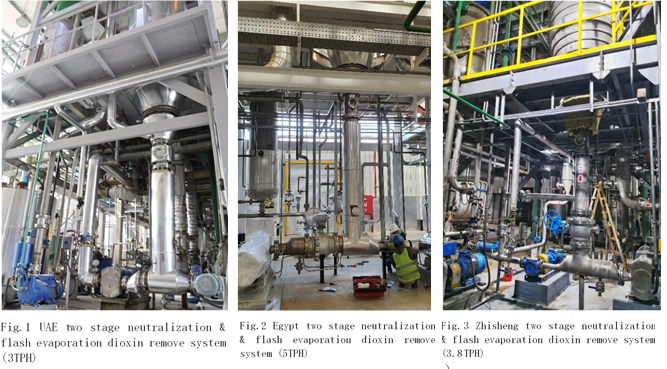
This system adds a flash evaporation system to the two-stage neutralization loop to achieve low-dioxane SLES production.
The sulfonated product from the sulfonation system is sent to the 1# Neutralization Reactor (R1401). At the same time, lye and process water are accurately measured separately by mass flow meters and then sent to the 1# Neutralization Reactor.
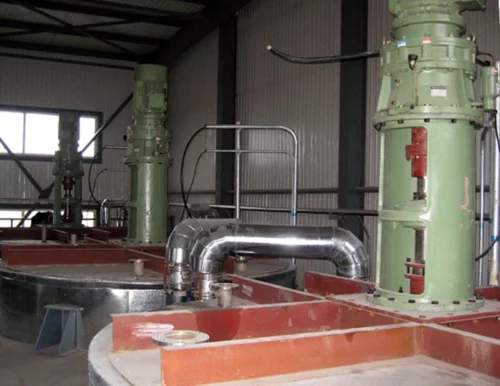
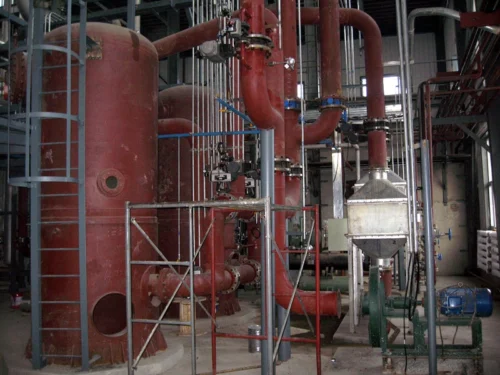
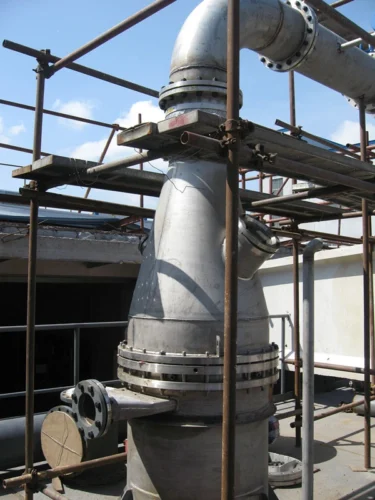
A special six-layer agitator is installed in the neutralization reactor to stir and mix the materials step by step, completing the neutralization process. After neutralization, the product is sent to the Flash Evaporator (S1401), where the SLES slurry is dehydrated by flash evaporation under vacuum. Dioxane is also removed from the slurry through its azeotropic property with water.
The Monomer Recycling Pump (P1406) feeds the slurry back to the inlet of the 1# Neutralization Reactor, forming a closed recycling loop. After the reaction products are fully reacted and the pH value is fine-tuned, the material is sent to the product modulation tank.
The addition amount of lye is automatically adjusted by the pH automatic adjustment meter installed at the outlet of the 1# Neutralization Reactor. The addition amount of stabilizer is automatically adjusted by the pH automatic adjustment meter installed at the outlet of the 2# Neutralization Reactor. Through this two-stage adjustment, a stable pH value can be achieved.
The gas mixture containing dioxane is condensed in the Condenser (E1401). The condensate is then automatically discharged by the level control system.
Characteristics of the Low-Dioxane SLES Production System
A. Stable and Accurate pH Automatic Adjustment
A mature two-stage neutralization system is adopted. The 1# Neutralization Reactor is used for primary pH regulation, while the 2# Neutralization Reactor is used for fine pH adjustment.
B. Flash Evaporation System in the Two-Stage Neutralization Loop
A flash evaporation system is added to the two-stage neutralization loop. By making full use of the heat generated during neutralization and the characteristics of flash evaporation, the system can remove dioxane while achieving better energy-saving performance.
C. Characteristics of ZJS’s Flash Evaporator
- A fine-spray porous nozzle is used. The number of nozzles is determined according to the production capacity. The design of the fine-spray porous nozzle ensures that the specific surface area of the material per unit volume is as large as possible, while avoiding excessive atomization. This helps achieve the best dioxane removal result. The dioxane removal rate of ZJS’s Flash Evaporator can reach over 85%. For example, in the project for Union Chemicals Factory LLC in the UAE, the dioxane content was reduced from 50–60 ppm to 7–8 ppm after treatment, as shown in the attached test certificate.
- To achieve the best neutralization result, the fine-spray porous nozzle design ensures that the neutralization system works under a certain positive pressure.
- A gas-liquid separator is installed inside the equipment to prevent gas-liquid entrainment and reduce material consumption.
- The inner wall of the equipment is mirror-polished, with no material residue. The equipment is designed and manufactured according to sanitary requirements.
- The equipment has a compact structure and is about 2 meters lower than similar equipment, making maintenance easier and saving installation space.
D. Stable Condensate Discharge and Vacuum Operation
A liquid tank is installed at the bottom of the condenser. Through the high- and low-level automatic control system, the condensate is automatically discharged, and the vacuum system operates stably without fluctuation.
Dioxane Removal for Low-Concentration SLES
Low-concentration SLES, such as 30% SLES, is easy to foam after disturbance or impact. This can cause serious gas-liquid entrainment and make the vacuum level difficult to control.
By adding a non-disturbance flash evaporator structure to ZJS’s original flash evaporator, low-concentration SLES can be dehydrated effectively, and dioxane can be removed at the same time.